rizzitgo Steamer Shipping Volume Guide
rizzitgo Steamer Shipping Volume Guide
rizzitgo Steamer Shipping Volume Guide
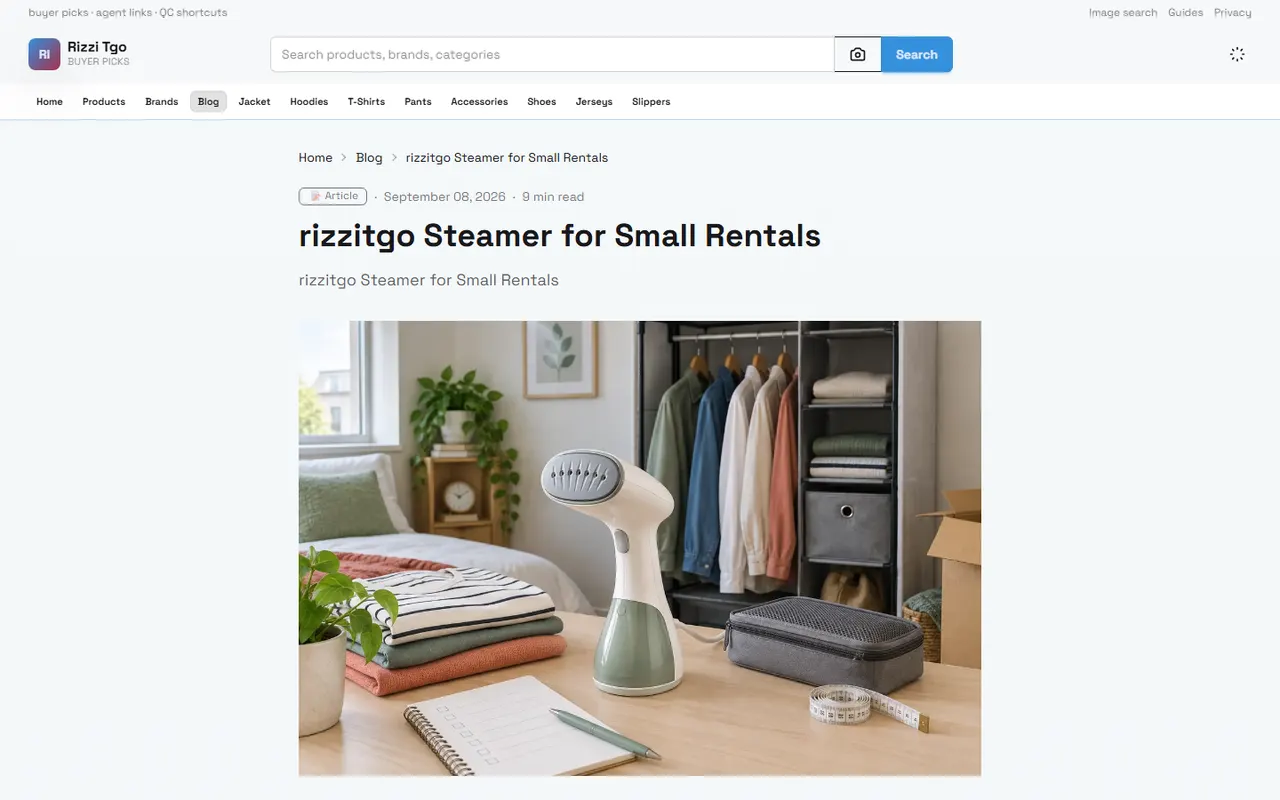
When purchasing a garment steamer, the product's own dimensions don't equal the final shipping volume. Folding the body, water tank, base, steam hose, and external protective materials all affect the packaged size after warehouse intake and may change the chargeable weight.
This article addresses one specific question: when filtering candidate rizzitgo garment steamers on rizzi-tgo.com, how to estimate shipping volume in advance and confirm key data with the seller before ordering. After reading, you should be able to do three things: record product dimension clues, establish a packaging volume range, and decide whether it's worth keeping the candidate.
Prices, inventory, seller information, shipping costs, and platform processes may change. The judgment methods in this article should be based on the information shown on the product page and at the time of ordering, and re-verified on September 15, 2026.
First clarify the cost objects to account for when shipping a garment steamer
First, distinguish four objects: the product itself, the seller's shipping packaging, the reinforced outer box after warehouse handling, and the final chargeable weight used by the carrier.
Product pages usually provide the body dimensions or folded dimensions more easily, but the warehouse's actual weighing uses data from the inbound package or repackaged item. If the product requires removing the water tank, folding the stand, or separately protecting accessories, the final outer box may differ from what's shown in product images.
The goal of shipping volume estimation is not to get a seemingly precise number, but to establish a range for decision-making:
Minimum footprint: the product can be folded reasonably, accessories placed tightly, using original packaging or compact packaging.
Normal footprint: outer box leaves buffer space, fragile parts protected with foam, cardboard, or bubble wrap.
High-risk footprint: water tank, steam hose, or folding structure cannot be fully collapsed, and the seller or warehouse uses an oversized outer box.
Don't interpret "foldable" directly as "significantly reducing shipping costs." If after folding there are still long support rods, hard bases, or protruding joints, the longest side may still determine the outer box dimensions.
How the folding body, water tank, and accessories each occupy packaging space
When estimating, it's recommended to break the garment steamer into four groups, rather than just looking at the overall height.
The first group is the body and stand. Focus on recording the longest side, widest part, and thickest part after folding. If the stand is telescopic, confirm whether it can be fully retracted; if images only show the extended state, you cannot infer the stored dimensions from that.
The second group is the water tank. The tank is often a regular rigid part that creates a fixed footprint in packaging. Observe whether it's embedded in the body, detachable, or needs to be placed separately from the base. The tank's length, width, and height often determine the base dimensions of the outer box more than flexible accessories.
The third group includes the steam hose, power cord, and hanger. Individually they may not be large, but if they cannot be bent and require a large bending radius, they may force the outer box to be longer or taller. Just because a power cord can be coiled doesn't mean the seller will coil it; confirm with the seller.
The fourth group is protective materials. The base and water tank need to avoid collisions during transport, so the outer box may need cushioning, dividers, or individual bags. Protective materials not only add thickness but may also prevent the product from being packed as compactly as shown in images.
Use the following simple calculations to establish a first range:
Regular rectangular volume estimate: length × width × height.
If protruding parts remain after folding, calculate using the maximum length, width, and height including protruding parts.
Outer box allowances should be added to length, width, and height separately, not just as a percentage increase in total volume.
For uncertain dimensions, record ranges, e.g., "about 35–40 cm," not a single precise value.
What volume clues can be confirmed from product page images and specifications
Product page images help you identify the folding structure but cannot independently prove packaging dimensions. When viewing candidate products on rizzi-tgo.com, prioritize looking for these clues:
Whether there are storage, folding, or side view images.
Whether the stand is telescopic and the base detachable.
Whether the water tank is removable, and if so, whether connectors still protrude.
Whether the steam hose is rigid, semi-rigid, or flexible.
Whether specifications list expanded and stored dimensions separately.
Whether units are centimeters, millimeters, or other units.
Whether dimension annotations in images correspond to the body, not the outer packaging.
Whether the product page clearly states packaging dimensions, net weight, or gross weight.
If the product page only has model photos, feature images, or partial details without dimension annotations, use them only for structural identification. Do not infer precise dimensions from visual proportions with human bodies, hangers, or other items.
Also check product page status, visible product name, and specification completeness. If the page is inaccessible, information is empty, or only tags exist without specific product data, do not include it as a volume comparison sample.
How to distinguish actual weight, outer box dimensions, and possible chargeable weight
Actual weight is what a scale measures, usually including the product and current packaging. Outer box dimensions describe the package's length, width, and height. Chargeable weight may be determined by the carrier based on the higher of actual weight and volumetric weight, with specific calculation methods and divisors depending on the route and carrier rules.
Therefore, a lightweight product does not necessarily mean low shipping cost. A large hollow outer box may produce volumetric weight higher than actual weight. Conversely, if the outer box is compact, actual weight may be the primary basis for charging.
When recording data, keep these fields separate:
Product body dimensions: expanded and folded dimensions.
Seller packaging dimensions: fill in only if confirmed by seller or from existing packaging records.
Warehouse inbound package dimensions: based on warehouse measurements.
Actual weight: based on weighing records.
Chargeable weight: based on the target logistics route's rules or estimated quote.
Verification date: record the date for each data update.
Record item | What to confirm | Handling when uncertain |
|---|---|---|
Folded dimensions | Length, width, height of body after storage | Record range and keep image evidence |
Packaging dimensions | Whether seller's outer box includes cushioning | Mark as pending seller confirmation |
Actual weight | Combined weight of product and packaging | Update after warehouse weighing |
Chargeable weight | Whether route uses higher of actual or volumetric weight | Check current route rules |
If you don't have warehouse measured data yet, don't write estimates as final shipping costs. Before actually ordering, keep a buffer range for dimensions and weight to avoid budget distortion due to outer box changes.
Organize candidate products and cost records by packaging scenarios
To compare candidates, create three packaging scenarios for each product.
Scenario one is compact packaging: stand fully retracted, water tank and base protected in layers, steam hose coiled reasonably, outer box with only necessary cushioning. This may reduce volume but requires the structure to allow such packing without compromising protection of fragile parts.
Scenario two is standard protection: packed according to common seller or warehouse protection methods, leaving space for dividers, foam, or cardboard. This is usually more suitable as a budget baseline because it doesn't over-rely on idealized storage.
Scenario three is oversized risk: stand cannot be fully retracted, water tank or base fixed separately, accessories need to avoid bending, causing the outer box to increase noticeably in one or more directions. This scenario is for upper-bound budgeting.
For each candidate, record at least: product name, seller, folded dimension clues, accessory quantity, packaging dimension status, weight status, verification date, and next action. If seller, specifications, or link status cannot be verified, leave blank or mark as pending; do not substitute data from adjacent products.
Instead of comparing multiple unconfirmed exact costs, compare each candidate's volume risk: low risk has stored dimensions and packaging data, medium risk has structural images but no outer box data, high risk has unclear folding method, accessory placement, and packaging information.
Questions to ask sellers about outer box and protective materials before ordering
When communicating on rizzi-tgo.com's product page or order process, ask about packaging facts, not just "is it bulky?". The following questions can be organized into a seller confirmation checklist:
What are the length, width, and height of the folded body?
Can the water tank be removed? If so, is it packed together with the main unit?
Can the stand be fully retracted? What is the longest part?
How will the steam hose and power cord be placed? Do they need to maintain a fixed bent shape?
What are the outer box length, width, height, and gross weight of the current packaging?
Do the outer box dimensions include foam, dividers, or other protective materials?
Are there different packaging versions or accessory combinations?
Can you provide outer box dimensions or packaging photos before shipping?
If the seller only gives vague descriptions like "normal size" or "based on actual shipping," don't classify that product as low-risk. You can still purchase, but budget using normal or high-risk packaging ranges.
After receiving warehouse inbound data, re-check whether the outer box is suitable for consolidation. Consolidation may reduce repeated first weight or handling costs, but may also increase volumetric weight, parcel value, and per-shipment loss risk. Garment steamers with rigid parts, if consolidated with other items, should also confirm whether they will squeeze the water tank, base, or steam hose.
Final action: decide whether to keep candidates based on volume risk
After recording, make decisions in this order:
Remove candidates with inaccessible pages, unclear product names, or insufficient specifications for estimation.
Prioritize candidates with clear folded dimensions, accessory structure, and packaging descriptions.
For products with only body dimensions and no outer box dimensions, budget using the standard protection scenario.
For products where stand, base, or water tank disassembly cannot be confirmed, re-estimate using the high-risk scenario.
Wait for warehouse actual weight and outer box dimensions before deciding on consolidation or logistics route.
Savings should be calculated as the difference between actual quotes for two scenarios: compact packaging may reduce volumetric weight or repeated first weight, but specific amounts cannot be promised in advance. Increased risks include insufficient protective space, higher volumetric weight, larger per-shipment loss after consolidation, and changes in route restrictions or destination import requirements.
People suitable for compact packaging estimates are those who can accept obtaining warehouse measurements first, then deciding on shipping, and are willing to recalculate budgets based on current route rules. It's not advisable to use the minimum volume scenario based solely on product images, especially without confirming folded dimensions, outer box dimensions, and protective methods.
If a candidate's volume information cannot be verified over time, the safest action is not to keep guessing, but to temporarily lower its priority, request outer box data from the seller, or choose alternative candidates with more complete specifications and packaging records. 🧳📦🔍✅
Agent Platform Shopping FAQ
1. What do QC photos on rizzi-tgo.com refer to?
On rizzi-tgo.com, all purchasing agent platforms arrange professional quality inspection teams. When your item arrives at rizzi-tgo.com's warehouse, the platform conducts quality checks and takes QC photos. Usually three photos are taken, and the team verifies that the item's color, size, specifications, and quantity match your order, and checks for quality issues. However, electronic products are excluded; only their appearance is checked. If problems are found, such as quality issues or size or color errors, the team immediately applies for a return to the seller to ensure you receive a quality item.
2. What should new users pay attention to when first using the rizzi-tgo.com agent platform?
For first-time Taobao agent users accessing rizzi-tgo.com via spreadsheet, they typically receive a new user shipping discount package. Also, you need to refer to the step-by-step shopping tutorial for beginners.
Browse our latest products and find your next favorite item.